
In October 2025, the United States will introduce a new mandatory fee called the Visa Integrity
Fee for nonimmigrant visas. This added cost has raised many questions: who must pay it, how
much it will cost, when it’s charged, and whether there are any ways to plan around it. Below is
a practical guide in plain language.
1. What is the Visa Integrity Fee?
● The Visa Integrity Fee is a statutory surcharge imposed under 8 U.S.C. § 1806, enacted
by the “One Big Beautiful Bill” (Public Law 119-21).
● It is in addition to the existing visa application (MRV) fees, SEVIS (if applicable), and
any reciprocity fees.
● The fee becomes effective starting in fiscal year 2025 (October 1, 2025).
● For FY 2025, the fee is set at $250.
● In subsequent years, the fee will be adjusted upward based on inflation (via the
Consumer Price Index).
2. Who must pay the fee? Who is exempt?
Who pays:
● Any foreign national who is issued a nonimmigrant visa (e.g. visitor, student,
exchange, worker) from a country that is not part of the Visa Waiver Program.
● It applies to many visa categories: B-1/B-2 (tourist/business), F/M/J (students /
exchange), H-1B, L-1, O-1, TN, dependent visas (H-4, J-2, F-2), etc.
● The fee is charged only at the moment of visa issuance if the visa is refused, the
fee is not collected.
Who is exempt:
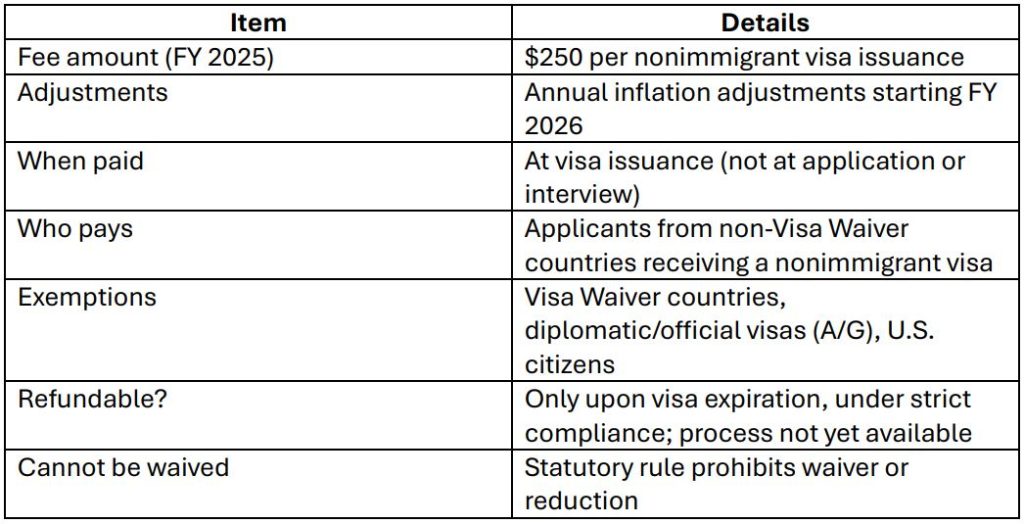
● Applicants from Visa Waiver Program (VWP) countries (because they do not get a
visa).
● Certain diplomatic or official visa categories (e.g. A, G visas) may be outside its scope,
depending on regulations.
● U.S. citizens or those applying for immigrant visas are not subject to this nonimmigrant
fee.
3. How much is the fee and how is it calculated?
● For FY 2025, the fee is $250 per nonimmigrant visa issuance.
● The law sets that starting in FY 2026 and thereafter, the fee will be automatically
adjusted for inflation (using the Consumer Price Index).
● The law also states that this fee cannot be waived or reduced it is mandatory under
statute.
● A portion of the collected fees may be reimbursable, under strict conditions (see section
below).
4. When do you pay the fee?
● The fee is collected when the visa is issued, not during application or interview.
● If the visa application is refused, the fee is not charged only successful issuances
trigger the charge.
● Because the operational rules are still being developed, consulates will likely integrate
the payment at the visa printing stage or passport return stage.
5. Reimbursement: When and how
The statute provides a reimbursement mechanism, but with strict conditions:
● To be eligible for reimbursement after visa expiration, the visa holder must prove that
they:
● Fully complied with all conditions of the nonimmigrant status (no unauthorized work, no
major violations)
● Did not apply for an extension beyond the authorized stay and departed the U.S. within
5 days after that period ends
● Or, if they changed status lawfully or adjusted status to permanent residence, they may
still qualify
● However, a reimbursement process has not yet been operationalized. There is no
published procedure, timeline, or mechanism for refunding as of now.
● Therefore, applicants should assume the fee is not refundable in practice, and
preserve all documentation (visa issuance receipts, stamps, travel records) in case a
refund path is later opened.

6. Strategies to avoid surprises and plan ahead
1. Budget the extra cost early
Incorporate an additional $250 (or more, if adjusted by inflation) into any visa cost
estimates.
2. Clarify payment responsibility in advance
For employees, students, or sponsored individuals decide ahead whether the
sponsor/employer or the applicant pays this fee.
3. Time your consular visa issuance
If possible, avoid unnecessary visa renewals or new consular visits after October 1,
2025, unless required, so you may delay the extra charge.
4. Maintain lawful status while inside the U.S.
If you can extend or change status inside the U.S. without leaving, you may minimize the
number of times you must pay the fee for re-entry.
5. Document your compliance fully
Keep clean records entry/exit stamps, not overstaying, not working without
authorization to preserve eligibility for a possible reimbursement in the future.
6. Stay informed
The State Department, DHS, and consulates will issue guidance on payment
procedures, receipt issuance, and refund applications. Follow official updates.
7. Summary table