
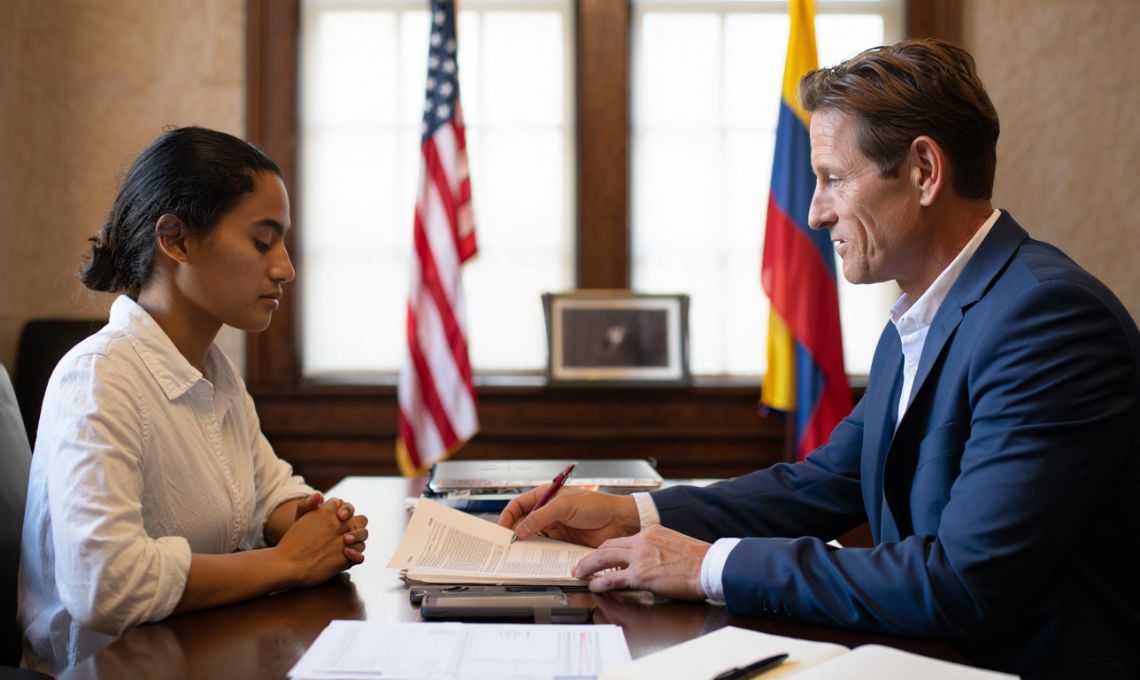
For many Colombians pursuing permanent residence in the United States, the biggest obstacle is not the consular interview, the financial requirements, or the wait times. The true challenge is something far more delicate: inadmissibility.
“Inadmissibility” refers to laws that prevent a person from entering the U.S. or obtaining
immigration benefits because of past errors such as unlawful presence, fraud or
misrepresentation, unauthorized entries, status violations, or certain criminal activity. For many, the only possible remedy is the I-601 or I-601A Waiver.
But the waiver is not a simple form. It is a highly discretionary, fact-intensive, and emotionally
complex request where a weak presentation can result not only in denial, but in years of family
separation.
This article explains the risks and errors most applicants face especially Colombians in the
U.S. and why legal strategy is essential.
1. What does it mean to be “inadmissible”?
Inadmissibility means the government determines a person is not eligible to enter the U.S. or
obtain permanent residence because of:
● Unlawful presence
● Fraud or misrepresentation (common in prior tourist visa applications)
● Entry without inspection
● Status violations
● Certain criminal offenses
● Prior removal orders
● Health-related issues
For many Colombians, the most common causes are unlawful presence and inconsistencies in
prior consular applications or interviews.
2. Waivers are not automatic: they are discretionary
Filing an I-601 or I-601A does not guarantee approval, even when the applicant technically
qualifies.
Officers evaluate:
● The applicant’s credibility
● The level of extreme hardship on the qualifying relative
● The strength and organization of the evidence
● The seriousness of the immigration violation
● Rehabilitation and honesty
● Humanitarian factors
● The totality of the circumstances
Two similar cases can receive completely different outcomes depending on how persuasively
the waiver is argued.
3. Who can apply for a waiver? Who qualifies as a
“qualifying relative”?
In the I-601A (unlawful presence waiver):
Qualifying relatives include:
● U.S. citizen or permanent resident spouse
● U.S. citizen or permanent resident parent
Children do NOT qualify for demonstrating extreme hardship.
In the I-601 (waivers for other grounds of inadmissibility):
Eligible relatives depend on the type of inadmissibility, but usually include:
● U.S. citizen or resident spouse
● U.S. citizen or resident parent
The key requirement: extreme hardship, a standard significantly higher than the emotional
difficulty expected in a family separation.
4. The most common mistakes that lead to denials
Mistake #1: Treating the waiver like a simple form
A waiver is not a document it is a legal argument.
A successful filing requires:
● A detailed hardship narrative
● Psychological evaluations
● Medical evidence
● Financial records
● Country condition reports
● Affidavits
● Legal citations
● A clear explanation of the underlying inadmissibility
Mistake #2: Hiding information out of fear
Omitting facts or giving incomplete answers is considered misrepresentation and can create a
new inadmissibility ground.

The government already has access to your history.
Honesty is critical.
Mistake #3: Relying on notarios or unlicensed consultants
Many denials come from poorly prepared waivers submitted by non-attorneys.
Common issues include:
● No legal framework
● Weak hardship analysis
● Missing supporting evidence
● Poorly structured narratives
● Lack of country-condition research
Mistake #4: Misunderstanding the risks of leaving the U.S.
For applicants who must travel to Colombia for their consular interview, a poorly prepared
waiver can leave them stranded outside the U.S. for:
● Months
● Years
● Or permanently, if the waiver is denied
Preparation before leaving the U.S. is essential.
Mistake #5: Underestimating the emotional and financial impact
Extreme hardship may include:
● Medical conditions
● Psychological vulnerabilities
● Financial instability
● Dependents
● Safety concerns abroad
● Lack of medical access
● Elderly parents or children with special needs
Each must be supported with strong evidence.
5. Extreme Hardship: The heart of the waiver
The hardship must go beyond normal emotional distress.
It must show:
● Severe medical consequences
● Inability to access treatment abroad
● Dependence on the applicant’s income
● Significant psychological harm
● Safety risks in the applicant’s country
● Disruption of family stability
The argument must be supported by detailed documentation and a strong legal explanation.
6. Conclusion: A waiver is a strategy, not a form
The I-601/I-601A is one of the most demanding, life-changing, and discretionary immigration
processes.
It requires:
● Legal research
● Carefully curated evidence
● Psychological and medical documentation
● A cohesive narrative
● Risk assessment
● Knowledge of consular practice
For many Colombians, the waiver is the only path to a Green Card but only if prepared with
precision.
Speak with an attorney before taking your next
step
At AnaMaria Rivera Law Firm, LLC, we analyze your immigration history, evaluate your
inadmissibility risk, and develop a customized waiver strategy designed to maximize approval.
Schedule a consultation before leaving the U.S. or filing your I-601/I-601A.