
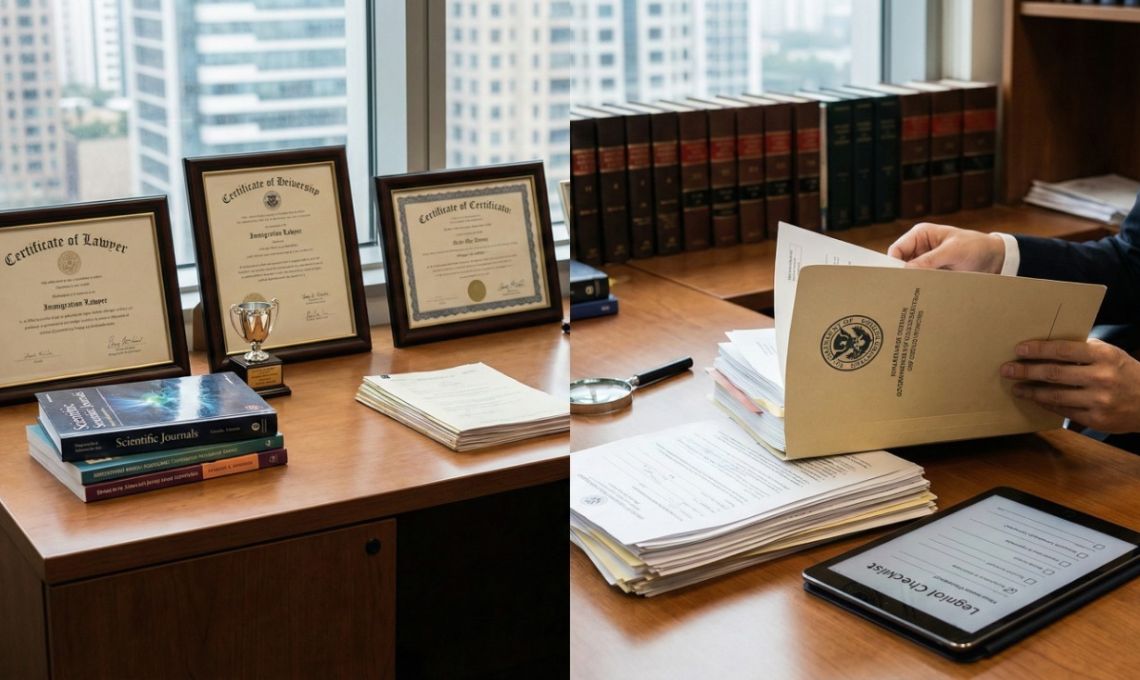
The EB-1A visa is one of the highest-level immigration categories in the U.S. system. It is
intended for individuals of extraordinary ability professionals at the very top of their fields:
senior engineers, distinguished scientists, CEOs, elite artists, innovators, athletes, and thought
leaders with significant recognition.
Yet even highly qualified candidates receive unexpected denials. Why?
Because three of the most powerful EB-1 criteria are often ignored, poorly documented, or
minimally explained, leading USCIS to conclude that the applicant has not shown “sustained
national or international acclaim.”
This article explains the three most overlooked EB-1A criteria, why they are essential in
USCIS’s internal review process, and how to properly document them to maximize approval.
Understanding the EB-1A standard: It’s not enough to be good you must be extraordinary
The law requires meeting at least 3 of 10 criteria, or having a major one-time achievement like
a Nobel Prize.
But what many applicants miss is this:
Meeting three criteria does not guarantee approval.
USCIS performs a final “Totality of the Evidence” / Merits Determination, where they examine whether the individual truly stands at the top of their field.
This is where most EB-1 cases fail: the applicant proves three criteria technically, but the
narrative and documentation do not convince USCIS of extraordinary ability.
The 3 EB-1 criteria applicants most often underestimate
These are the criteria that—when done correctly—can transform an EB-1A petition.
CRITERION #1: “Judging the work of others”
(Reviewer, evaluator, panelist, jury member, referee)
Why USCIS values it so much:
It shows authority, recognition, and credibility.
Being asked to evaluate others means the applicant is trusted as an expert.
Common mistakes:
● Listing reviews without proof of invitations
● Missing screenshots from editorial systems
● No evidence of journal rankings or prestige
● Minimal explanation of technical relevance
How to document it correctly:
Official invitations
Screenshots of review portals
Proof of publications reviewed
Rankings of journals/conferences
Clear explanation of the applicant’s expertise
This criterion is one of the strongest indicators of extraordinary ability.
CRITERION #2: “Original contributions of major significance”
This criterion is powerful, but also one of the easiest to fail if handled incorrectly.
What USCIS really wants:
● Evidence that the contribution has been adopted, cited, or implemented
● Proof of measurable impact
● Independent expert opinions
● Commercial or industry adoption
● Patents used in real-world applications
What is NOT enough:
Self-descriptions of importance
Letters without external evidence
Internal achievements with no industry impact
Contributions that cannot be verified
How to strengthen this criterion:
Citations
Usage metrics
Implementation reports
Evidence of commercial results
Letters from independent experts

This criterion often determines whether the case is ultimately approved.
CRITERION #3: “Authorship of scholarly or technical articles”
Applicants assume this criterion is only for academics, but USCIS accepts:
● Technical articles
● Industry publications
● Case studies
● Thought-leadership pieces
● High-level business analyses
Common problems:
● Articles without impact data
● No evidence of the publication’s prestige
● Lack of accessible links or archives
● Internal reports not suitable for EB-1
How to present it convincingly:
✔ Verified publications
✔ Metrics (views, downloads, citations)
✔ Journal or media rankings
✔ Explanation of technical contribution
This criterion is extremely useful for engineers, executives, scientists, and creators.
These three criteria are strongest when used together
When an applicant:
● Publishes articles
● Judges the work of others
● Produces major contributions
USCIS sees a consistent pattern of leadership, expertise, and recognition at the top of the
field.
Warning: Evidence matters more than accomplishments
USCIS is not evaluating how talented someone is they evaluate what can be proven.
Many brilliant professionals receive denials because:
● Evidence is weak or unorganized
● Letters are vague or repetitive
● Criteria are not tied to regulations
● The final merits argument is missing or poorly drafted
This is where strong legal strategy becomes essential.
Conclusion: EB-1 success is not about achievements…
it’s about documentation
Most high-level professionals already have extraordinary accomplishments.
What they need is a legal strategy that transforms their achievements into clear, persuasive,
and verifiable evidence that meets USCIS standards.
Documenting these three overlooked criteria correctly can dramatically strengthen an EB-1A
case.
Get your EB-1A case evaluated by experts
At AnaMaria Rivera Law Firm, LLC, we help engineers, scientists, CEOs, artists, researchers,
and other top professionals build strong EB-1A petitions aligned with USCIS’s internal review
standards.
Schedule a consultation and learn how to build a winning EB-1A strategy.