

For many green card applicants, the Visa Bulletin is confusing. Yet understanding it is essential
to know when you can move forward. In this guide you’ll see how to read the October 2025
bulletin step by step, with real examples.
1. What is a “priority date”?
The priority date is your place in line for an immigrant visa. For employment-based cases:
- If your case requires a labor certification (PERM), it is the date the Department of Labor
received the certification. - If no certification is needed (or for the I-140 directly), it is the date USCIS received the
I-140 petition.
Your priority date determines when you can file your adjustment of status (if in the U.S.) or get
an immigrant visa (if abroad).
2. What is the Visa Bulletin and what does it include?
Each month, the Department of State publishes the Visa Bulletin, which includes:
- Final Action Dates (Chart A)
- Dates for Filing (Chart B)
These charts are broken down by category (family, employment) and by country of chargeability
(for example, “Rest of World,” China mainland born, India, Mexico, Philippines).
- If your priority date is earlier than the cutoff date shown, it is “current” for that stage.
- The bulletin also uses symbols:
○ C = Current → visas are available to all qualified in that category
○ U = Unavailable → no visas can be issued that month in that category
3. When can you file adjustment of status or visa consular application?
It depends on which chart USCIS allows in that month:
- If USCIS permits use of the Dates for Filing chart, then applicants whose priority dates
are earlier than those dates may file Form I-485 even if the visa isn’t yet available. - If USCIS does not allow it, you must wait until your priority date is earlier than the Final Action Dates before your petition can be approved.
For October 2025, USCIS has confirmed they will use the Dates for Filing chart for
employment-based cases. That means you may be eligible to file I-485 if your date qualifies
under that chart.

4. Real examples from October 2025
Let’s look at some sample entries from October 2025:
Employment-Based Categories (EB):
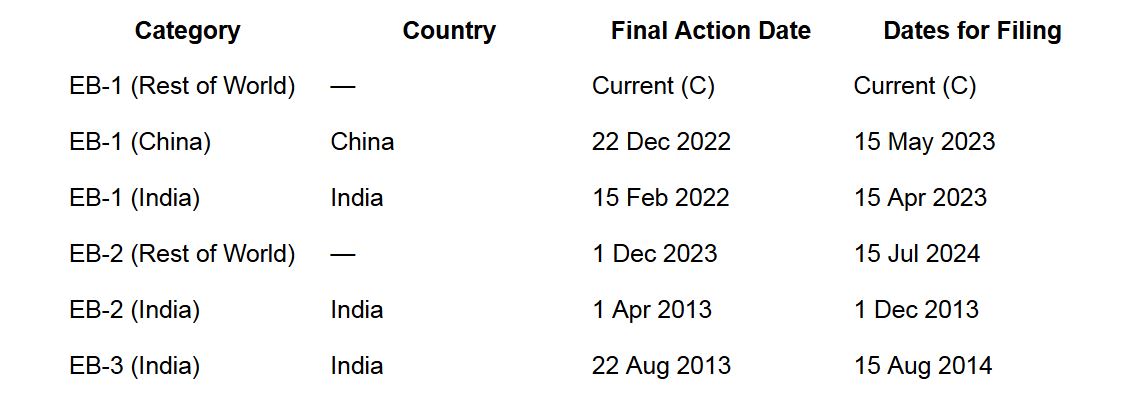
Examples:
● Suppose you are the beneficiary of EB-1 in China, with priority date January 1, 2023:
- Under Final Action, January 1, 2023 is after December 22, 2022, so you are not
eligible yet. - But under Dates for Filing, January 1, 2023 is before May 15, 2023, so you
could file your adjustment of status in October 2025 (since USCIS is using
that chart).
● Suppose you are from India under EB-2 with priority date July 1, 2013:
- For Final Action, the cutoff is April 1, 2013, so your date isn’t current yet.
- But for Dates for Filing, the cutoff is December 1, 2013, so you are eligible to
file your I-485 in October 2025.
These illustrate clearly the difference between being eligible to file and being eligible for
approval.
5. What to do month by month
- Check the Visa Bulletin every month (usually published between the 10th and 15th).
- Identify your category (EB-1, EB-2, EB-3, etc.) and your country of chargeability.
- Look at both charts (Final Action / Dates for Filing).
- Confirm whether USCIS is using Dates for Filing this month.
- If your priority date is earlier than the Dates for Filing cutoff, you can file I-485 (if
eligible). - However, for approval, your priority date must be earlier than the Final Action cutoff.
6. Risks and practical tips
- Don’t file too early: if you file before USCIS allows, your petition could be rejected.
- Prepare in advance: even if you can’t file yet, gather documents (medical exam,
translations, certificates). - Retrogression: sometimes Final Action dates move backward. If your application is
pending when your date becomes non-current, USCIS will “freeze” processing until it
becomes current again. - Policy changes: USCIS may switch which chart is valid in a given month. Stay updated.
- Keep records: always keep your priority date and copies of each month’s bulletin for
reference.